There’s one thing that’s hard to deny: The Real Housewives of Salt Lake City’s Mary Cosby is a polarizing figure. She’s been a magnet since the series premiered in 2020. She’s kooky, uninhibited, seemingly aloof at times, and as accused by some longstanding rumors and speculation detailed in the latest TLC three-part docuseries The Cult of the Real Housewife, she’s potentially a ruthless cult leader.
The series delves into the history of her Salt Lake City Pentecostal church, Faith Temple, which she inherited from her grandmother following her sudden death in 1996. Months later, Mary, alleging it was her grandmother’s dying wish, married her stepgrandfather Robert Cosby, who is 20 years her senior, and together, they took over the church and caused major uproar and dissemination.
Videos by PopCulture.com
The church’s origins are explored unlike ever before. And for the first time on such a platform, former church members, associates, bloggers, and even family members detail the alleged abuse they say they’ve suffered at the hands of the Cosbys. PopCulture.com spoke with executive producer Deniese Davis and director Julian P. Hobbs about the explosive investigative piece.
PopCulture.com: I got a chance to watch all three parts. Obviously it was very interesting and entertaining and also informative. So there’s a ton of Real Housewives scandals or figures to examine. For you guys, what made Mary the go-to for this docuseries?
Deniese Davis: I think we have to look at how we came into this docuseries. I am not a fan of Housewives. By not a fan, I mean, I’ve never sat down and watched any of the series, although I know there are several of them. And so I was actually very unfamiliar with Mary’s story and, and the allegations that were surrounding her church. This came to me by my partners [directors] Julian Hobbs and Elli [Hakami], who came across an article that Cheyenne Rowntree wrote in The Daily Beast that came out right around the end of the first season of the show where one of the first accusations and allegations around Mary, and Robert running a cult.
And so this article was shared with me and I found it fascinating. As someone who does not watch the show and was not familiar, I was immediately taken in by looking into a lot of the initial reporting she had done with some of the participants and former congregation members. And as a producer and as someone who has produced documentaries and are always looking at very interesting stories, I remember telling myself if this was a documentary, I would be devouring this because it just had all of the unique angles needed to tell a very riveting story that was very personal and very truthful. This wasn’t intentional in terms of how we sat down to say, “Let’s tell a story about Mary.” It really was based on Cheyenne’s initial reporting.
Julian P. Hobbs: Right, no, Deniese is 100% right about that. I would say that while I personally binged Real Housewives of Salt Lake City in order to research Mary, and I’ve been aware of the franchise, this really is not about the Real Housewives. It’s about Mary Cosby and Bishop Robert Senior. I have no beef at all with the Real Housewives franchise. It’s enjoyed by many, many people and is obviously hugely successful. What we were curious about is we often look at how people in power abuse that power, especially around mind manipulation, cults and coercion, and so that’s what drew us to the topic.
PC: Now, being as though you guys hadn’t been familiar with Mary or The Real Housewives of Salt Lake City franchise specifically prior to coming across The Daily Beast article, in your research, when you binged it and when you did your extensive research, what did you guys find polarizing about Mary and about the allegations?
JPH: That’s, well, I, I would say the core thing, that my, actually it’s [ex-Faith Temple congregant] Ernest Enoch says in the film, and his brother and sister on the film, and they have been the second generation members of this church. They have deep knowledge about its origins, they’ve been with it for a long time until they broke, is that, it’s about division. And whether you’re dividing believers from unbelievers, whether you’re dividing siblings, whether you’re dividing married couples, whether you’re dividing families – this seems to be the overarching thing that happens again and again and again and again and again. And I think what our documentary is looking at is what’s the fallout of Mary and Bishop creating these divisions within this formerly healthy faith community.
And what’s the ramifications for that, for people’s spiritual well-being as well as their mental health well-being and their personal journeys in their lives. When these accusations came out in season one and season two, the franchise itself posited “Is Mary part of a cult?” People, until now, haven’t heard from the people who are on the inside of that operation. So they haven’t been given a platform to tell their story. So, I think those who are victims of this division now finally have a place to hear their voices.
DD: I would add that I feel like because it is reality TV, at the end of the day, there is usually a skewed narrative and a perspective as it relates to what most people have, what they seem to think they know is the truth behind the story, or at least just mainly of what Mary presents. However, what we’re doing is really taking a chance, on what Julian said, to give these victims and former congregant members, and these family members, a chance to really share their side of their experiences and their trauma and their pain.
And I think that to me, what I found the most polarizing going down my rabbit hole, is that so many people feel like they know the story because of what they’ve seen. It touched on it, at least as it relates to the cult allegations, but only from the Housewives’ perspective. We’ve only found that there were a few accounts of bloggers and whatnot who have done some interviews, but we’re getting a chance to really allow them to have a larger platform and to share their experiences with everyone.
PC: Now, the docuseries features a lot of former friends, family members, associates of Mary or the church, and it’s one thing to speak to an editorial piece, as you mentioned, like The Daily Beast piece. But it’s another thing to get on camera and really give away your anonymity. Was it difficult to get people to speak, or were they eager? Or was it like pulling teeth during these interviews at times?
JPH: I think it was a mix. I mean, Deniese can chime in, but some people were very thankful that finally they could speak truth to power and that these allegations were going to be heard. With other people, there was a lot of trust building that had to go on to make sure that we weren’t going to be exploitative in the way we told their story and that we would honor our word to be truthful to what they said, and that it was going to be done with tact and care. It was a mixed bag. And to some degree, as others joined, more and more people felt like, “OK, I feel safe because this is a very close knit community of people.”
DD: I would add that I think one thing that was really important to the majority of our participants was that everyone also was really passionate about getting the chance to be able to give Rosemary Cosby, known as Mama, a voice and a history here. They were all very much wanting to make sure that we were able to shine a light on the origin story of Faith Temple and what this church really meant to them. As you see, most of them, if not all of them, grew up in this church and were a part of it prior to the leadership transfer of power.
And so for them, if they were going to come in and share their side of the story, they also wanted assurances that we were going to tell Mama’s story and to be able to speak on just exactly what she meant to them and we were able to build that trust and being able to provide that storyline and that was a that was a big part of every single person would mention that it was very important to them that this was not a documentary that was going to disparage Mama’s lineage and what she meant. And that was something they really wanted to uphold.
PC: Was there any attempt to get anyone from the network or production company to share their insight or thoughts? I imagine with this docuseries coming out, this is not something that Bravo necessarily wants to have to do crisis PR on.
DD: No. this wasn’t a docuseries about the Housewives. And so we didn’t feel like that was necessary. We did, of course, ask Mary and Robert Sr. if they would like to be in the documentary to answer the allegations, and they declined.
PC: Now, the docuseries talks about Mary’s exit in Season 2. She did attend the reunion. And then her return a few seasons later, and the shift in her storyline. She was initially guarded and to some, she came off as much more brash. And then when she returned, she seemed more interested, or at least willing to participate in forming friendships with the cast, and she delved into her issues with her son that has played out publicly. And it sort of helped change some of the public perception about her and not necessarily erase, but temporarily forget the allegations that were running rampant a few years prior. How does this further contribute the duality of her?
JPH: Honestly, we can’t really speak to the Real Housewives narrative. One thing we do know is that narratives move fast in these types of shows and and characters evolve and, and that’s part of the entertaining factor of it. Reality doesn’t work like a reality TV show. For the people we talked to, these are deep, deep seated pains that have gone on for decades in some cases, certainly for years. And so honestly, I’m not really interested in how it impacts Mary, except that I think she has some obligation to speak to these people who we’re talking about. Her sister, we’re talking about her cousin, we’re talking about family members that were in there for multiple generations. So I’m less interested in reality TV. I’m more interested in whether Mary has been running a coercive cult and did it harm people.
PC: I really liked that you guys did delve into in the second episode, the history of the church and her grandmother’s hard work and legacy. That was something that I’ve been trying to wrap my head around. As a fan of the franchise, and as a journalist who has to cover these shows, I was always trying to figure out more about her grandmother. And in my research, I wasn’t able to find a lot of that stuff online. So kudos to you guys for delving into that. But it also left me with more questions about where things stand today, and I know that that’s kind of where you guys left off with the docuseries. What is the current state of the church? And what happened to the various businesses Mama owned? She built an entire community and safe haven for her congregation and it’s seemingly disappeared.
JPH: We want to be a little careful that we don’t speak outside of the documentary. We did look into this, of course. The church itself, that property still exists, but almost all those businesses are gone and. Why they’re gone, I think that’s an open-ended question. I would speak a bit more to the shift between what Mama represented to that community and helping people fulfill their potential, caring for those who were poor and destitute and all of those great values that you see in that Pentecostal church, and then the erosion of those values once Bishop Sr. and Mary took over. And that those are from firsthand accounts. It changed.
DD: And, to his point, we couldn’t speak too much about the allegations surrounding any of the businesses, any of the financial abuse other than what our participants told us about their own experiences. But I think anyone can see whether or not these places currently still exist or operate as a business. And, from my own accounts, I can tell you, I have not found them.
PC: I wanna talk a little bit about race. Now, some people who watch this may say there’s obviously a lot to focus on regarding the Mormon religion and its controversies because she lives in Salt Lake City, Utah. Some may feel that Mary is being unfairly targeted with a docuseries like this. You’re talking about the Pentecostal Church and a potential cult when she lives in a town where another religion is primary with its own controversies. What is your response to this?
DD: Well, there was absolutely no targeted intention around Mary. This is really just a story about one woman, one church, and the story behind what has been presented on a reality television show. And so at the end of the day, she just happens to be a Black woman and she just happens to be the only Black woman on this cast of this particular franchise. And for us it was really the story itself. And these victims and these people that have been impacted, and have dealt with real trauma and pain and have carried that for many years and have never really had an outlet to be able to voice their version of events because they are having to watch her on this show and spew her own narrative and not be able to have a chance to have their own voice heard.
And so what we did was really present an opportunity for them to present that. And so the fact that she is a Black woman and that this is a Pentecostal church, those are facts. But it definitely is not in any of our intentions to be unfairly targeting her or necessarily taking her. I mean, there are plenty of other documentaries and stories about the Mormon Church. People can go watch those, and that was not our trajectory. We did not sit down to sit and target any of those things.
PC: Last question: I love documentaries. I’m always interested in true crime and stuff surrounding cults. But I do know that cults are a really difficult idea for some people, or a lot of people, to wrap their heads around, especially when you’re talking about a public figure or someone who has a certain level of popularity on a global platform like Housewives. And just the idea that people can be coerced or manipulated into doing certain things and tithing and things of that nature. What do you say to people who may find it difficult to unpack this?
JPH: Well, hopefully that’s why we have one of the leading experts in the docuseries. Dr. Steven Hassan, who is one of the world’s leading experts on cults, and he gives you the cult playbook. And of course, cults can manifest in many different ways. Not all are religious. There have been cults of personality with regular people who have certain ideas. But they have a common set of attributes. And you nailed it when you talk about coercion. Coercive behavior is used to have people carry out certain acts that may be against their best interest. Dr. Hassan lays out the sex, control, money kind of triangle that’s almost universal in cults.
I’m sure many Housewives fans will turn up and watch the docuseries because they’re just fans and that’s what they’re gonna do. I also think, to your point though, you’re gonna get a lot of people who are really curious about how cults operate. How do you put a cult together? What does it feel like to be inside a cult? And of course cult leaders don’t say I’m a cult leader. People inside the church who are in our documentary only realize once they got out and got perspective. And so, my wish is that actually you don’t have to know anything about Real Housewives, just like Deniese didn’t before she started making the film, but if you’re just curious about cults, I think this is an interesting look, tearing back the curtain, how do they actually operate from the inside?
DD: And the last thing I’ll add is I feel like it’s relatable and people. Anyone can find the cult-like experience fascinating because the reality is it can happen to anyone. Anyone who is very vulnerable to be prey to the methods of power and abuse in all kinds of ways. And so, I think that’s what tends to happen when viewers are just always fascinated by the subject matter regardless of where or who it’s talking about or the world that it’s exploring.
And lastly, you guys mentioned earlier in our chat, the idea of potential fallout and accountability. You guys spent significant time with all of the subjects who’ve been interviewed. What do you think a potential fallout could look like?
DD: I don’t know. I think we’re waiting to find out, too. We can’t predict that. And at the end of the day, I think the docuseries leaves many open-ended questions for viewers to answer for themselves. And I guess we’ll have to see how this plays out in real time, but I don’t think we have any expectations of one thing or another, because we also worked really hard to also not definitively say, factually, that she is running a cult, nor is Mary a villain. I think we posed a larger question because we ourselves left being unsure of what the real, real nugget of truth here was, which is, is she a victim? Is she a villain? Does she know what she’s doing? We can’t speak for her and we can’t answer that.
The Cult of the Real Housewife docuseries is available to stream on HBO Max.
Most Viewed
-
Photo Credit: BBC -

The logo for the streaming service Peacock (Credit: Peacock) -
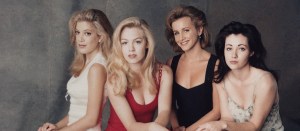
Actors Tori Spelling, Jennie Garth, Gabrielle Carteris, and Shannen Doherty of Beverly Hills 90210 pose for a portrait in Los Angeles, California, September 1993. (Photo by Aaron Rapoport/Corbis/Getty Images) -
PARIS, FRANCE – MARCH 08: (EDITORIAL USE ONLY – For Non-Editorial use please seek approval from Fashion House) Aubrey Plaza attends the Lacoste Womenswear Fall/Winter 2026-2027 show as part of Paris Fashion Week on March 08, 2026 in Paris, France. (Photo by Marc Piasecki/WireImage)